March 28, 2026
Hip Joint Pain Physical Therapy Exercises for Post-Injury Recovery
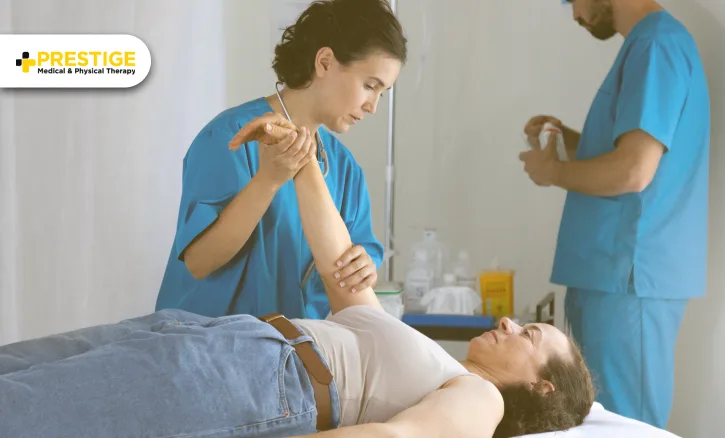
Recovering from a hip injury is a journey that requires patience and a strategic approach. The hip joint is a central pillar of your body and handles immense pressure during every step you take. When you suffer from an injury, your mobility can drop significantly. Many people find that even getting out of bed causes a sharp sense of pain and stiffness.
Our specialists at Prestige Medical Physical Therapy focus on restoring your movement through evidence-based methods. Our goal is to move you from a state of limitation back to your normal physical activity level.
Whether your discomfort stems from sports injuries or general wear and tear, a structured plan is vital. Physical therapy exercises for hip pain are not just about movement. They are about rebuilding the foundation of your lower body. By following a guided exercise program, you can address the root cause of your discomfort rather than just masking the symptoms.
1) Hip Joint Pain and Recovery
The hip is a ball-and-socket joint that relies on a complex network of ligaments and tendons. When an injury occurs, these structures can become inflamed. In some cases, a fluid-filled sac called a bursa becomes irritated, leading to a condition known as bursitis. This can make the entire area feel tender to the touch.
(I) Common Causes and Medical Conditions
Many different health conditions can lead to persistent hip issues. Arthritis is a frequent culprit, often categorized as a chronic condition that requires long-term management. According to the Centers for Disease Control and Prevention, roughly one in four adults in the United States has been diagnosed with some form of arthritis. This diagnosis often brings about significant pain and stiffness in the joints.
Other medical conditions, like labral tears or tendinitis, are also common after sudden movements or falls. Statistics show that more than 300,000 older adults are hospitalized for hip fractures each year in the U.S.. Regardless of the specific cause, the primary focus of recovery is always on protecting the joint while rebuilding strength.
(II) The Role of Blood Flow in Healing
Healing cannot happen without proper circulation. Increased blood flow delivers essential nutrients and oxygen to the injured tissues. Movement is the most effective way to stimulate this process. When you engage the surrounding muscles, you create a pump-like effect that clears out inflammatory markers.
Prestige Medical Physical Therapy experts emphasize that movement is medicine. Even small, controlled movements can prevent the joint from becoming frozen or excessively stiff. This is why we start with low-impact stretches before progressing to more strenuous tasks.
2) Prepare for Your Exercise Program
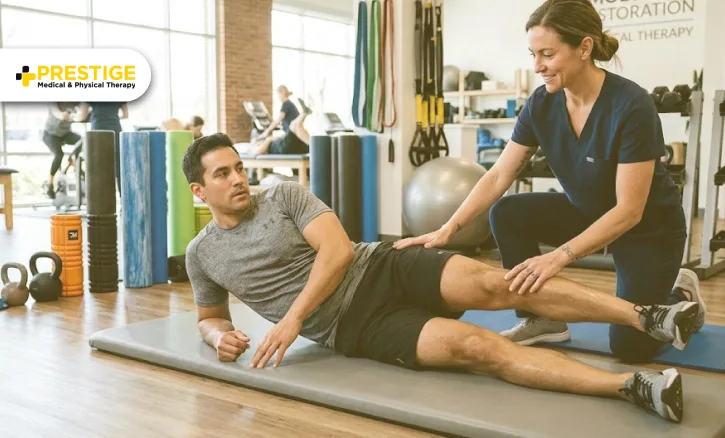
Starting a new routine can feel overwhelming when you are in pain. It is important to know that you are not alone in this process. Before you dive into specific movements, you need to understand the baseline of your physical health.
(I) What to Expect During Your Initial Visit
Your first step should always be a professional evaluation. This helps identify which specific muscles are weak and which ones are overcompensated. You might find it helpful to learn what to expect at your first physical therapy session so that you feel prepared for the assessment.
During this time, a therapist will look at your range of motion and your gait. They will ask about your history with sports injuries or any underlying health conditions. This information allows them to craft a treatment plan that is safe for your unique body.
(II) Managing Pain and Stiffness
It is normal to feel some resistance when you first start moving an injured hip. However, there is a big difference between a healthy stretch and a painful strain. The experts at Prestige Medical Physical Therapy suggest using heat or ice to manage discomfort before and after your sessions.
The goal of your exercise program is to gradually increase what your body can handle. We want to reduce the risk of re-injury by ensuring your form is perfect. Consistency is the key to turning a chronic condition into a manageable one.
3) Primary Physical Therapy Exercises for Hip Pain

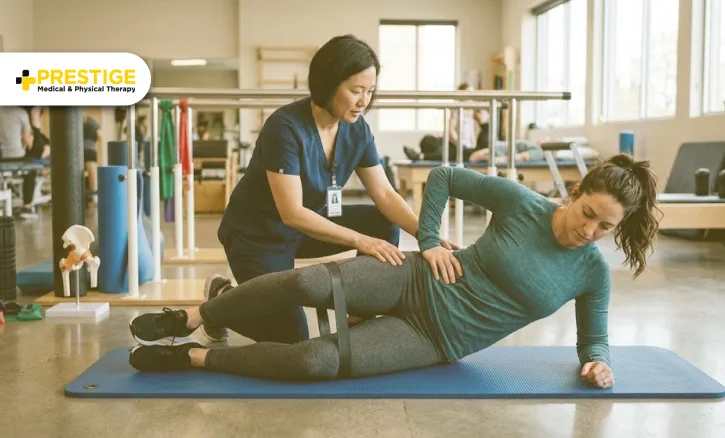
The following exercises are commonly used in post injury recovery. They focus on mobility, stability, and strengthening the muscles that support the hip joint.
(I) Mobility and Range of Motion
Before you can build strength, you must ensure the joint can move through its natural path.
Seated External Hip Rotation: Sit in a sturdy chair with your feet flat on the floor. Cross your left leg so that your ankle rests on your right knee. Gently press down on your left knee until you feel a stretch in your hip. It is important to hold the stretch for 20 to 30 seconds. Repeat on the opposite side to ensure balance. This helps maintain the rotation needed for walking and climbing stairs.
The Butterfly Stretch
Sit on the floor with your knees bent and the soles of your feet touching. Hold your feet and gently lower your knees toward the ground. You will feel a stretch in your inner thighs and hips. Hold the position while taking deep breaths.
(II) Strengthening the Muscles
Once your mobility improves, you can start to strengthen your hip. This protects the bone and cartilage from unnecessary impact.
The Leg Raise
Lie flat on your back on a mat. Keep one knee bent and feet flat to support your lower back. Lift your left leg slowly until it is about 12 inches off the ground. Keep your leg straight throughout the motion. Hold the position for a second at the top. Slowly lower the leg back to the start position. Complete 10 repetitions and then repeat on the opposite side.Bridges for Glute Activation
Lie on your back with your knees bent and feet flat on the floor. Squeeze your glutes and lift your hips toward the ceiling. Your body should form a straight line from your knees to your shoulders. Hold the position for three seconds before you return to the starting position. This move is essential for stabilizing the hip joint during daily activities.
4) Beyond the Hip Joint
The human body is an interconnected web. Often, pain in one area is caused by a weakness in another. Hip pain frequently correlates with issues in the lower back or even the knees.
(I) Connection to Chronic Back Pain
If your hip is not moving correctly, your lower back often has to pick up the slack. This can lead to a secondary chronic condition in your spine. Many patients wonder whether physical therapy actually works for chronic back pain when their primary issue started in the hip. The answer is a resounding yes because physical therapy addresses the entire kinetic chain.
Research published by the National Institutes of Health indicates that patients who engage in physical therapy for musculoskeletal pain see a 50 percent reduction in the need for invasive surgeries. By strengthening the surrounding muscles, you take the pressure off both your hip and your back.
(II) Benefits of Chiropractic Manipulation
Sometimes, a joint can become restricted in a way that exercise alone cannot fix. In these cases, manual therapy can be very beneficial. You might consider chiropractic manipulation for everyday pain to help realign the joint and improve nervous system function.
Prestige Medical Physical Therapy often utilizes a multidisciplinary approach. Combining exercise with manual adjustments can accelerate your recovery timeline. This ensures that the hip joint is moving freely while the muscles are being trained to support it.
5) Progress to High-Impact Activity

The final phase of recovery is returning to the things you love. This might mean running, playing sports, or simply playing with your grandchildren.
Gradual Loading: You should not jump straight back into running. Start with fast walking or swimming.
Monitoring Symptoms: If pain and stiffness return after a session, it means you might need to scale back.
Occupational Therapy: If your job requires heavy lifting or long hours of standing, occupational therapy can help you adapt your movements to stay safe.
The National Health Interview Survey suggests that joint pain is a leading cause of work disability in the United States. By taking your exercise program seriously, you are protecting your career and your long-term independence.
Frequently Asked Questions
How often should I perform these hip exercises?
Most patients see the best results when they perform their stretches daily and their strengthening moves three to four times a week. However, you should follow the specific treatment plan provided by the team at Prestige Medical Physical Therapy.
Is it normal to hear a clicking sound in my hip?
A clicking or snapping sound can be common and is often just a tendon moving over a bone. However, if the click is accompanied by pain, it could indicate a labral tear or an issue with a fluid-filled sac. You should have it evaluated by a professional.
Can physical therapy help with age-related hip pain?
Yes, it is highly effective. Strengthening the muscles around the joint can significantly reduce the symptoms of arthritis and other age-related health conditions. It helps maintain your ability to perform daily activities without help.
When can I return to sports after a hip injury?
You can usually return to impact activity once you have regained full range of motion and your strength is equal on both sides. Your physical therapist will use specific tests to determine when you are ready to play safely.
Disclaimer: This article provides general information and does not constitute medical advice. Please contact Prestige Medical and Physical Therapy for personalized diagnosis and treatment.
Recent Blogs